What Is a Pangram in a Spelling Bee?
In the NYT Spelling Bee, a pangram is a word that uses all seven letters from the honeycomb at least once, including the center letter. Every official puzzle guarantees at least one pangram. A valid pangram earns its normal word score plus an extra 7-point bonus, making it one of the highest-scoring moves possible. Some puzzles contain two or even three pangrams.
Definition of a Pangram
A spelling bee pangram is a word that uses every letter provided in the puzzle at least once, including the mandatory center letter. Successfully discovering a pangram usually comes with a significant bonus, making it one of the most satisfying accomplishments in spelling bee today challenges. Whether you are playing casually or in a competitive session, pangrams remain the highlight of every puzzle.
Pangram vs. Perfect Pangram
While all pangrams use every letter, not all are equal. A perfect pangram takes it one step further by using each letter exactly once, no repeats. These are incredibly rare in spell bee puzzles and discovering one can feel almost magical. Perfect pangrams are the pinnacle for advanced players who love mastering complex letter combinations.
Why Pangrams Are the Most Rewarding Find
Finding a pangram in a spelling bee puzzle is thrilling because it hits multiple rewards at once:
- ➥It gives the highest point bonus available in the game.
- ➥It can push your rank up toward levels like “Genius” or “Amazing”.
- ➥And let’s face it, it simply makes you feel clever and accomplished.
Is There Always a Pangram in the Spelling Bee?
Yes, every NYT Spelling Bee puzzle contains at least one pangram. This is by design: the NYT puzzle editors construct each daily hive specifically to include a valid pangram word. In fact, the puzzle is built around the pangram, with the remaining letters chosen to allow as many other valid words as possible.
Here are the key facts about pangram frequency:
- ➥Every daily NYT Spelling Bee puzzle has at least one pangram; this is guaranteed.
- ➥Some puzzles include two pangrams; occasionally three appear in a single hive.
- ➥A perfect pangram, where each of the 7 letters is used exactly once, appears rarely perhaps once every few weeks.
- ➥On spellbee.us, free unlimited puzzles also always contain at least one pangram per hive.
If you are stuck and cannot find the pangram, use a spelling bee pangram hint: look at the first letter of the center letter and try combining it with each outer letter in turn. This narrows possibilities quickly without spoiling the answer entirely.
Spelling Bee Pangram Rules
The rules for a valid spelling bee pangram are straightforward but strict. A word qualifies as a pangram only if it meets all of the following conditions:
- ➥The word must contain all seven letters shown in the hive, the center letter plus all six outer letters.
- ➥The center letter must be included; this is required for all valid words in any Spelling Bee puzzle.
- ➥Letters may be repeated. For example, if one of the 7 letters appears three times in the word, it still qualifies as a pangram as long as all 7 unique letters appear at least once.
- ➥The word must be at least 4 letters long (all valid Spelling Bee words must be).
- ➥No proper nouns, hyphenated words, or obscene words are accepted. Standard Spelling Bee rules apply.
- ➥A perfect pangram additionally requires each letter to appear exactly once, no repeats at all.
When you enter a pangram, the game highlights it distinctly, typically with a golden shimmer on the NYT version, confirming you have found one. For more read our guide on Spelling Bee Rules.
Spelling Bee Pangram Hint - How to Get Help Without Spoiling It
If you are stuck on today's spelling bee pangram, the best approach is to use a structured hint system rather than immediately reaching for a full solver. Here are the most effective hint strategies, from least to most revealing:
Hint Level 1 - First Letter Hint
The spelling bee pangram first letter is often enough to unlock the answer. Focus on words starting with each of the 7 letters in turn, and mentally check whether you can build a word that uses all remaining letters. Most players find the pangram within 5-10 minutes using this approach.
Hint Level 2 - Letter Count Hint
Count the letters in the pangram. In the NYT Spelling Bee, most pangrams are 7-9 letters long. If the puzzle has 7 unique letters and the pangram uses each once, it is exactly 7 letters (a perfect pangram). If letters repeat, the pangram will be 8+ letters. Knowing the length narrows your search dramatically.
Hint Level 3 - Use a Spelling Bee Pangram Solver
A spelling bee pangram solver or spelling bee pangram finder accepts the 7 hive letters and returns all valid pangram words. Use this only after exhausting the above hints, as it removes the satisfaction of discovery. On spellbee.us, you can play unlimited free puzzles and develop your pangram-finding instincts without needing a solver.
For Today's NYT Spelling Bee Pangram
The NYT Spelling Bee pangram today changes every day at midnight Eastern Time. If you need the specific spelling bee pangram answer today or the NYT Spelling Bee pangram hint today, the NYT Spelling Bee community (Wordplay blog, Beehaw, and dedicated Discord servers) publishes daily hints, usually a first-letter clue posted around 8 AM Eastern before revealing the full answer later in the day.
Spelling Bee Bingo vs Pangram - What Is the Difference?
Players sometimes confuse spelling bee bingo and a pangram, they are completely different achievements:
- ➥Spelling Bee Pangram: A single word that uses all 7 letters in the hive at least once. It is a word-level achievement, one word, all letters.
- ➥Spelling Bee Bingo: A puzzle-level achievement where you find at least one valid word starting with each of the 7 letters in the hive. It requires multiple words, not just one.
In short: a pangram is about one perfect word, while a bingo is about the breadth of your word list. You can achieve bingo without ever finding the pangram, and you can find the pangram without achieving bingo. Both contribute to your rank, but the pangram gives the larger single-word bonus.
How Pangrams Work in Spelling Bee Games
In the Spelling Bee, scoring works as follows: a 4-letter word scores 1 point, and words of 5 or more letters score 1 point per letter. A pangram earns its full per-letter score plus a 7-point bonus. So a 7-letter pangram scores 7 + 7 = 14 points. An 8-letter pangram scores 8 + 7 = 15 points. This makes the pangram by far the most efficient scoring word in any puzzle, finding it can jump you one or two full rank levels in a single entry.
The Role of the Center Letter
Every valid word in a spelling bee game must include the puzzle’s center letter. This means that a pangram is not just a long word; it must intricately weave in the center letter, making the challenge both fun and strategic. The center letter ensures that players engage with the core of the puzzle rather than simply creating random long words.
Word Length and Bonus Points
Most pangrams are seven letters or longer, which naturally results in more points. Combine this with the special pangram bonus, and it’s easy to see why spotting one is such a score booster. Players often find that focusing on longer words and strategic letter combinations helps identify pangram opportunities faster.
Can There Be More Than One Pangram?
Yes! Some spelling bee today puzzles contain multiple pangrams. That is part of the challenge: you never know if you have completely conquered the hive until you dig deeper. Exploring different letter combinations can reveal hidden pangrams that were not obvious at first.
Examples of Pangrams in Spelling Bee Puzzles
Famous Pangram Examples
Some spelling bee pangrams become legendary among players and are remembered long after the puzzle is solved. In fact, many of these pangrams appear alongside the hardest spelling bee words, challenging even the most advanced players.For example, if a hive's letters were H, A, N, D, B, G, and S (with A as center), a valid pangram would be HANDBAGS, it uses all 7 letters, with A repeated. Real pangrams like this showcase clever letter combinations and strategic thinking in spelling bee games. Recognizing these patterns helps players spot future pangrams faster and improves overall gameplay.
Rare Perfect Pangrams
A perfect pangram is even more elusive. A word like CHIMNEY, for example, uses exactly 7 letters (C, H, I, M, N, E, Y) with zero repeats, making it a textbook perfect pangram if those were the day's hive letters. Perfect pangrams are highly prized because of the rare skill required to find them. For many spell bee enthusiasts, discovering a perfect pangram feels like uncovering a piece of word puzzle art, offering both high points and immense satisfaction.
How Often Do Pangrams Appear?
Most spelling bee today puzzles contain at least one pangram, but some may hide two or even three. Perfect pangrams, however, are much rarer and might only appear once in dozens of puzzles. Knowing this frequency can help players focus their strategy on spotting both common and rare pangrams. Regular practice increases your chances of identifying these valuable words more efficiently.
How to Find the Spelling Bee Pangram - Step-by-Step Strategies
Finding the spelling bee pangram faster is a learnable skill. Use these steps in order for most players to find the pangram within steps 1–3 without needing a solver:
Step 1 - Shuffle the Hive to Reveal Patterns
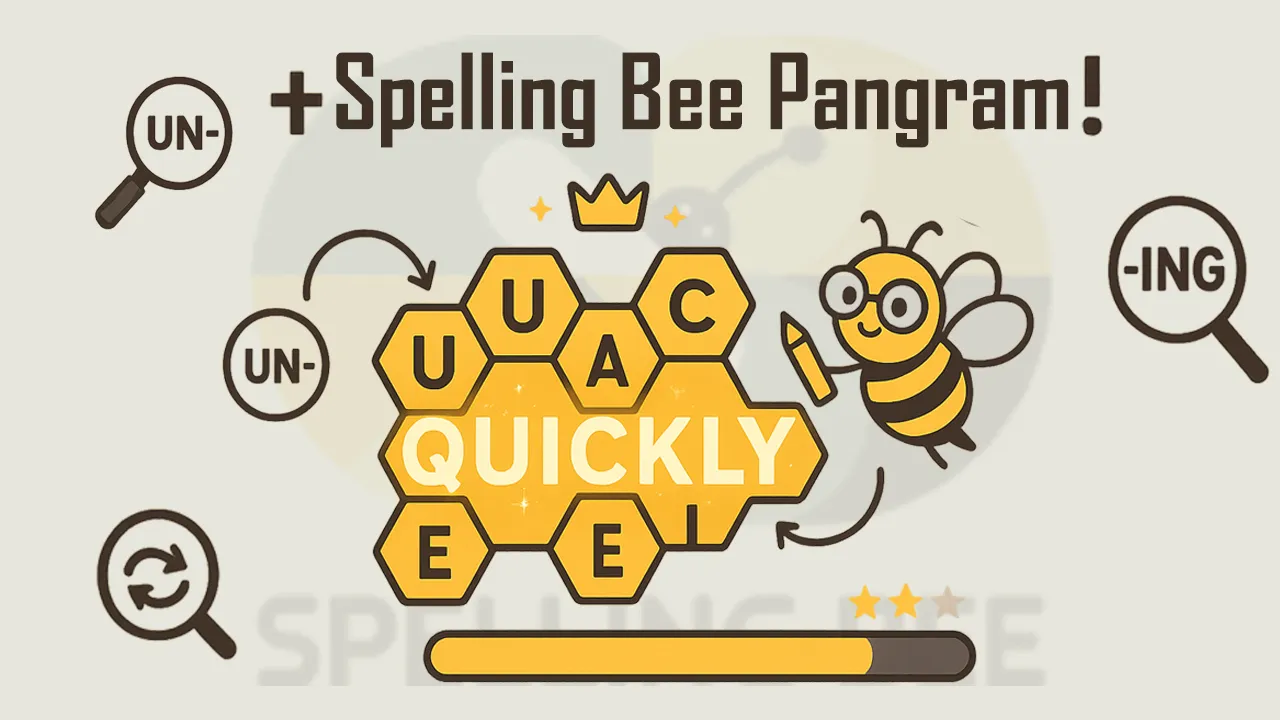
The shuffle button is an essential tool for any serious spelling bee player. By rearranging the letters in the hive, your brain can see patterns you might have initially missed. This simple technique often leads to the discovery of hidden spelling bee words and even complete pangrams, making it one of the fastest ways to reveal patterns you initially missed.
Step 2 - Look for Common Prefixes and Suffixes
Prefixes like re-, un-, and suffixes like -ing or -tion are the building blocks of many spelling bee pangrams. By combining these with smaller base words, you can expand simple words into longer ones that use all the letters in the hive. For example, adding -ing to a 4-letter word often leads to a 7+ letter pangram opportunity, boosting both points and rank.
Step 3 - Build from Smaller Words Outward
Begin by finding shorter spelling bee words and gradually expand them by incorporating the remaining letters. Many pangrams grow organically from these smaller roots, and this stepwise approach reduces frustration while increasing efficiency. This technique is especially useful in any puzzle where multiple pangrams may exist.
Step 4 - Use the Spelling Bee Pangram Finder or Word Lists
A spelling bee pangram finder or spelling bee pangram solver online accepts your 7 hive letters and returns all valid pangram words. Use these as training tools rather than real-time cheats.For grade-level vocabulary that helps you recognize more valid pangram words, see our Spelling Bee Words by Grade guide. Studying the results helps you recognize which letter combinations produce pangrams in future puzzles. On spelling bee unlimited page, you can practice pangram-finding without any paywall & limit. But if you are new then read our guide on How to Play Spelling Bee Game first.
Spelling Bee Pangram List - Common Patterns to Know
While today's specific NYT Spelling Bee pangram changes daily, certain letter patterns and word structures appear repeatedly across pangrams. Knowing these patterns is more useful than memorizing individual answers, because each puzzle's letters are unique.
Common pangram word structures in NYT Spelling Bee puzzles include:
- ➥Words ending in -TION or -ATION (e.g., words like "location," "notation") naturally include many distinct letters.
- ➥Words with the prefix RE- or UN- combined with a long root (e.g., "rebound," "unblock").
- ➥Compound-style words with two distinct roots, these tend to use more unique letters naturally.
- ➥Words ending in -LING, -MENT, or -NESS followed by a long stem.
For the NYT Spelling Bee pangram today specifically, check the NYT Wordplay blog, which publishes the daily puzzle pangram clue each morning. For unlimited pangram practice without a daily limit, play free at spellbee.us.
Why Finding a Spelling Bee Pangram Feels So Rewarding
There’s something uniquely satisfying about uncovering a spelling bee pangram in a puzzle. It’s not just about accumulating points, it’s the thrill of using every letter in the hive, cracking hidden patterns, and proving to yourself that persistence and strategy pay off. Whether you are playing a competitive round or a casual session, discovering a pangram offers an unmatched sense of accomplishment.
The Psychology Behind the “Aha!” Moment
When you find a pangram, your brain experiences a mini reward loop. The combination of challenge and success triggers a dopamine release, creating that memorable “aha!” moment. This feeling keeps spelling bee game enthusiasts coming back daily, pushing them to explore more complex puzzles and seek out rare pangrams. Even casual players find themselves hooked by this natural feedback loop of problem-solving and reward.
Vocabulary Growth and Learning Benefits
Searching for pangrams isn’t just fun, it’s educational. Engaging with longer, less common spelling bee words naturally expands your vocabulary. Many players take it further by exploring the etymology of pangram words, understanding their origins, and learning how the English language evolves. For students and enthusiasts alike, this makes spell bee puzzles a subtle yet effective learning tool.
Beyond the Game: Pangrams in Language and Writing
Outside of Spelling Bee, the word "pangram" also refers to any sentence using every letter of the alphabet, the most famous being "The quick brown fox jumps over the lazy dog." In the Spelling Bee context, however, a pangram specifically means a word (not a sentence) using all 7 hive letters. This distinction matters: users searching for a pangram definition spelling bee context should note that the Spelling Bee pangram is a single word, not a full-alphabet sentence.
Final Thoughts: Make Every Pangram Count
Spelling bee pangrams are not just bonus words; they are the centerpiece of each puzzle. A single pangram can jump you one or two full rank levels, and finding it independently is the most satisfying moment the game offers.
Use the three-step approach: shuffle the hive first, look for prefixes and suffixes second, and build outward from smaller words third. If you want unlimited pangram practice with no paywall, Spell Bee Unlimited includes at least one pangram in every free puzzle.