
The spelling bee game is a free daily word puzzle built around seven letters arranged in a honeycomb. Every word you form must be at least four letters long and must include the center letter. Letters can repeat within a word. Each puzzle hides at least one pangram, a word using all seven letters & worth a scoring bonus. A new puzzle drops every 24 hours at spellbee.us, with no account, no paywall, and no subscription required.
If you've been playing the New York Times version and hit its subscription wall, or you're just discovering the format for the first time, everything below explains exactly how to play the October 14, 2026 puzzle and how scoring and ranks work. Want more than one puzzle a day? SpellBee.Us also has Unlimited Mode for endless extra puzzles, a Solver and Hints if you're stuck, and Yesterday's Answers to check what you missed.
Master the Spelling Bee game online in four easy steps. Learn how to make words, find pangrams, and reach Genius rank. This simple guide is great for new players and daily word-game fans.
Look at the seven letters in the hive. Pick any combination that includes the center letter and is at least four letters long. You can repeat letters, so if your hive contains T, E, and N, a word like "TENET" is fair game even though it uses "E" and "T" more than once.
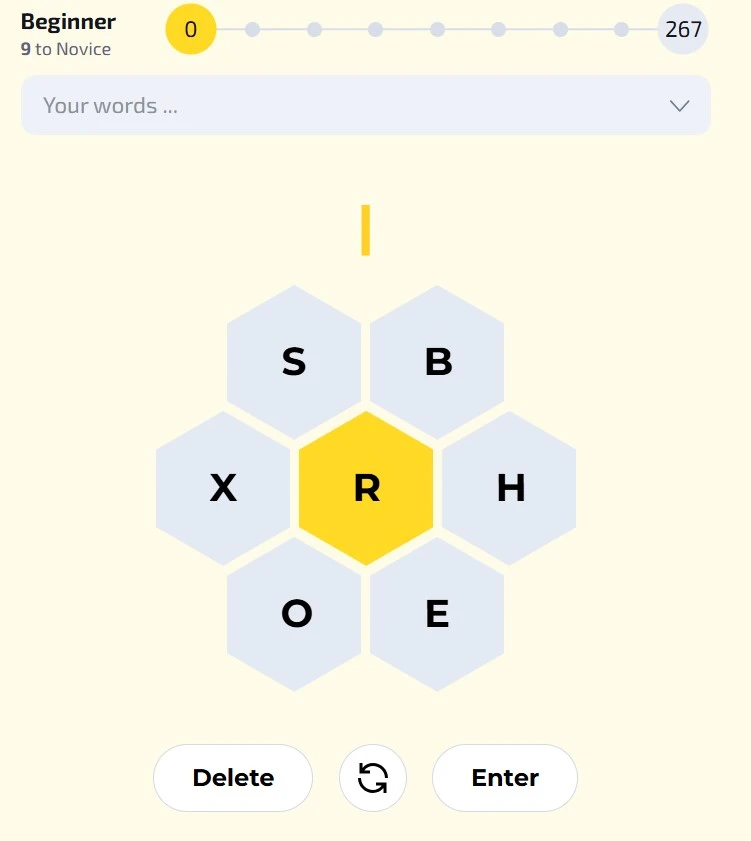
Every accepted word adds to your score (see the table below). If you're stuck, hit Shuffle, rearranging the letters visually breaks the pattern your eyes have locked onto and often reveals combinations you'd missed.
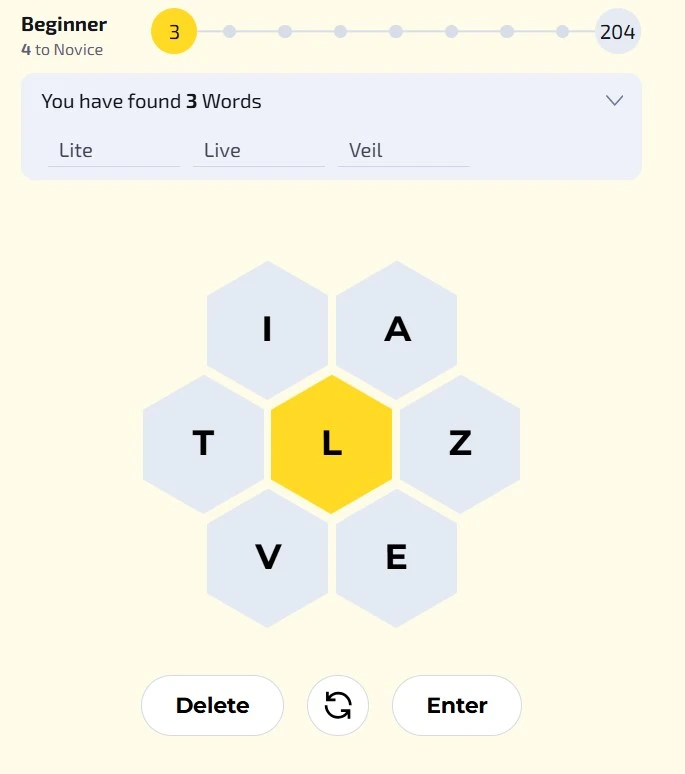
Every puzzle guarantees at least one word that uses all seven hive letters, the pangram. It scores the word's normal points plus a 7-point bonus, and finding it early often reveals other word patterns hiding in the same hive.
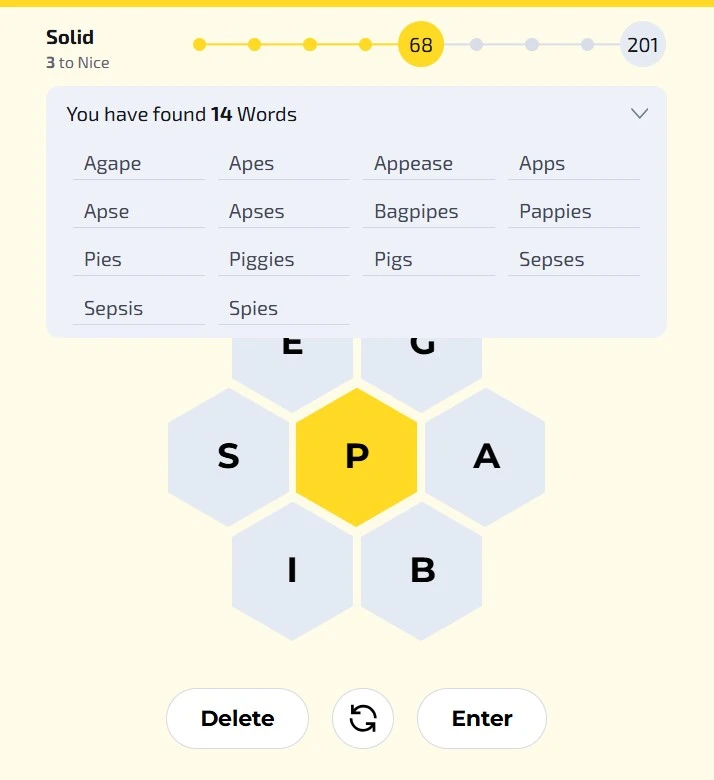
Your score maps onto a nine-level rank ladder from Beginner to Genius, with Queen Bee reserved for anyone who finds every valid word. Progress saves automatically. The puzzle resets every 24 hours, and once it does, you can check Yesterday's Answers to see the full word list and catch anything you missed.
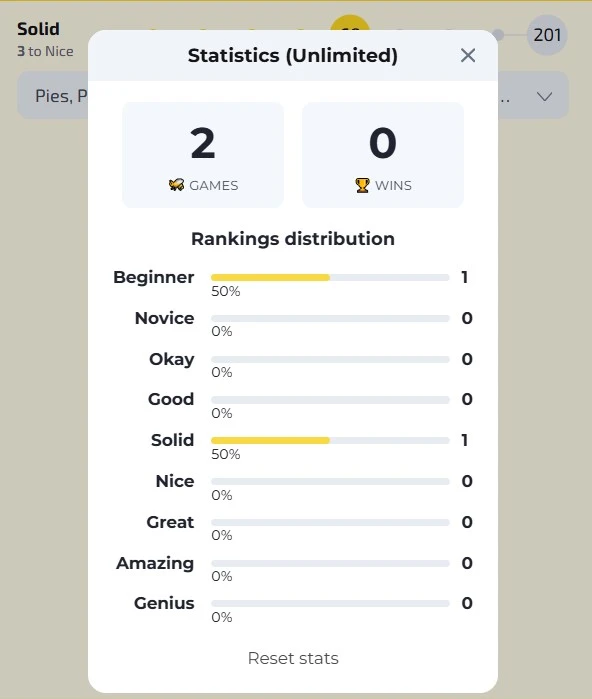
Spelling Bee is a word-construction puzzle. You're given seven letters arranged in a hexagonal hive, with one letter fixed in the center. Your task is to build as many valid English words as you can from those seven letters, following four fixed rules.
That's the entire rule set and it's deceptively simple. The difficulty comes from the fact that a 7-letter hive can usually produce dozens of valid words, and finding the last few is genuinely hard even for strong readers. That gap between "words you spot instantly" and "words you're missing" is what makes the format so replayable.
The format wasn't invented by a random web developer, it has a documented origin. The New York Times Spelling Bee debuted as a weekly print puzzle in 2015, created by puzzle constructor Frank Longo following a pitch from longtime NYT puzzle editor Will Shortz. A digital daily version, with a revised scoring system, launched in 2018 and is now edited by Sam Ezersky. That's a separate thing from the Scripps National Spelling Bee, the televised competition where students spell words aloud, same name, unrelated format. If you searched "spelling bee" hoping for either the word game or the competition, now you know which one you're looking at here: the word-puzzle game.
Knowing the format's lineage matters because it explains why so many free alternatives exist, including this one. The mechanic itself (seven letters, honeycomb, center-letter rule, pangram bonus) isn't proprietary; it's a well-established puzzle style that any site can implement fairly, with its own word list and validation logic.
| Word Length | Points Earned |
|---|---|
| 4 letters | 1 point |
| 5 letters | 5 points |
| 6 letters | 6 points |
| 7 letters | 7 points |
| 8+ letters | 1 point per letter |
| Pangram (any length) | Normal score + 7 bonus points |
Short words add up fast; long words and pangrams are what separate a "Good" score from a "Genius" one.
| Rank | What It Signals |
|---|---|
| Beginner | You've started |
| Novice | Building momentum |
| Okay | Solid early progress |
| Good | Consistent word-finding |
| Solid | Strong working vocabulary |
| Nice | Above-average performance |
| Great | You know the format well |
| Amazing | Elite-level word building |
| Genius | Roughly 70%+ of total available points |
| Queen Bee | Every valid word found |
Genius isn't luck. Reaching it consistently means you're sweeping suffix families (-ING, -ED, -TION), checking plural and repeated-letter combinations, and usually finding the pangram, all learnable habits, not one-off flashes of insight.
A pangram uses all seven hive letters at least once, in any order, possibly repeating some. Every puzzle has at least one, and it's worth chasing early, the 7-point bonus alone can be the difference between two full ranks.
Here's a strategy most guides skip: English letters aren't used equally often. The classic frequency ordering, E, T, A, O, I, N, S, H, R, D, L, U (often remembered as "ETAOIN SHRDLU"), reflects roughly how common each letter is across English text. In a spelling bee hive, this cuts both ways for pangram-hunting:
Combine that with a systematic suffix sweep (below) and pangram-hunting stops being guesswork. Still stuck on the October 14, 2026 pangram specifically? Our Hints page gives progressive, spoiler-free clues, and the Solver will find it outright if you'd rather not wait.
The October 14, 2026 puzzle is the same for every player, which is part of what makes it worth coming back to, you can compare your score and rank with friends who played the identical hive, not a randomized one. It resets every 24 hours at midnight local time, and progress within that puzzle saves automatically, so you can leave and pick up exactly where you stopped.
If one puzzle a day isn't enough, spellbee.us also runs Spelling Bee Unlimited, a separate mode with endless fresh puzzles on demand, ...but the game on this page is specifically the October 14, 2026 daily challenge.
If you searched "nyt spelling bee" or "spelling bee nyt" and landed here, you're likely one of the many players who've hit the New York Times paywall after using up free daily plays. The mechanic you love, honeycomb, pangram hunting, rank progression, isn't exclusive to NYT. Here's the practical difference:
| What Players Want | Spellbee.us | NYT Spelling Bee |
|---|---|---|
| Free daily puzzle | Always free | Limited, then paywalled |
| Account required | No | Required for full access |
| Yesterday's answers | Yes | Yes |
| Hints available | Yes | Limited |
| Device access | Any browser | Browser + app |
This isn't a claim of being "the" NYT game, it's an independently built puzzle using the same honeycomb format, with its own word list and validation logic, free of any subscription.
A lot of players searching "wordle spelling bee" are trying to place these games relative to each other. Here's the actual entity map, since none of the games are the same mechanic:
| Game | Core Mechanic | What It Trains |
|---|---|---|
| Spelling Bee | Build as many words as possible from 7 fixed letters | Vocabulary recall, retrieving words from memory under a constraint |
| Wordle | Guess one hidden 5-letter word in 6 tries using color feedback | Deductive elimination and logical narrowing |
| Waffle | Rearrange letters within a fixed grid to complete several intersecting words | Pattern-matching within a bounded grid |
| Buzzwords (Arkadium) | A honeycomb-format variant with a star/level progression layer | Same core mechanic as Spelling Bee, with added game-progression elements |
| Letter Boxed | Connect letters around a square to form words, with each new word starting with the last letter of the previous word | Word chaining, vocabulary recall, and strategic thinking |
Spelling Bee is the only one of these that asks you to generate language from open memory rather than narrow down or rearrange a fixed set, which is why it's often described as the most vocabulary-intensive of the daily word games.
Spelling Bee has a large adult following specifically because it's quiet, no timers, no flashing animations, no countdown pressure. It's a slower, more deliberate cognitive workout than most mobile games offer.
That's not just a marketing claim. A cohort study run through the PROTECT platform (a collaboration between the University of Exeter and King's College London) tracked over 19,000 adults aged 50 and older and found that participants who regularly did word puzzles scored measurably better on tests of grammatical reasoning and short-term memory, with an effect size comparable to being 8 to 10 years younger cognitively (Brooker et al., International Journal of Geriatric Psychiatry, 2019). Spelling Bee specifically draws on long-term vocabulary retrieval, a different cognitive demand than Wordle's short-term elimination logic, which is part of why word-game researchers treat the two as complementary rather than interchangeable.
Teachers use the daily puzzle as a short warm-up because it naturally reinforces the suffix and prefix patterns, -TION, -MENT, -ING, -LY, that show up constantly in academic vocabulary across subjects, without feeling like a worksheet.
For players training for formal spelling competitions, today's puzzle is a low-stakes way to drill vocabulary breadth and comfort with uncommon but valid words. Playing daily builds the habit; players who want to drill across many different letter sets in one sitting can move on to Unlimited Mode for extended practice.
If a word you're confident about gets rejected, it's not a bug, the game runs against a defined word list, and the rules explicitly exclude proper nouns, hyphenated compounds, and words considered too obscure for general play. Spellbee.us's word list is checked against a standard English dictionary source and updated when players flag legitimate misses, so if a common word gets rejected, you can report it and it will be reviewed. Need help finding words instead? Use Hints for gentle nudges or the Solver for the full list.
The spelling bee game is a word puzzle where you make words from 7 letters shown in a honeycomb. Every valid word must use the center letter, contain at least 4 letters, and may reuse letters. A pangram uses all 7 letters and gives you extra points.
Use the seven letters in the honeycomb to create words with four or more letters. Each word must include the center letter. Enter valid words to score points and move toward higher ranks.
"Spelling bee today" means the current daily puzzle and its set of 7 letters. The daily challenge changes regularly, giving players a fresh word puzzle to solve and compare with others.
A word can be real and still not appear on the game's accepted word list. Spelling Bee puzzles use a selected vocabulary list, so proper names, abbreviations, some specialized terms, and certain uncommon words may not be accepted. If you believe a familiar word is missing, it may be worth reporting it for review.
The letter S can make the puzzle much easier because it allows players to create many plural forms and other variations. Leaving S out helps keep the word count under control and makes players search for a wider range of vocabulary.
A regular pangram uses all seven letters in the honeycomb at least once. A Perfect Pangram is much rarer because it uses each of the seven letters exactly once, with no repeated letters.
There is no fixed number of answers in a Spelling Bee puzzle. The total depends on the seven-letter combination and can vary significantly from one puzzle to another. Some letter sets have relatively few answers, while others contain many possible words.
The percentage can vary from puzzle to puzzle, so there is no single reliable percentage for all players. Genius is reached by players who earn a high enough score, while Queen Bee requires finding every accepted word in the puzzle and is considerably more difficult.
You can use a separate dictionary or reference source if you want to check the meaning of a word. This can be especially useful when you discover an unfamiliar word and want to learn how it is used.
Yes, the same or a very similar letter combination can appear again. With many possible combinations, repeats may be uncommon, but seeing a familiar group of letters does not necessarily indicate a problem with the puzzle.
Abbreviations, initials, and many highly informal terms are normally not accepted. Some commonly used words may be included depending on the game's word list, but players should not expect every slang term or shortened form to work.
For the same daily puzzle, players are given the same set of 7 letters. This makes it possible to compare scores, words, and ranks with friends who are solving that day's challenge.
The daily puzzle resets according to the schedule used by the game. Your device's date and time settings can affect when a new daily puzzle becomes available.
Progress may be stored locally in your browser so you can return to the puzzle later. If you clear browser data, switch devices, or use private browsing, previously saved progress may not be available.
Older puzzle answers can be useful as a reference when available on the Answers page. Whether an older puzzle can be replayed depends on the features provided by the game.
Yes. Spelling Bee on Spellbee.us is free to play. You can access the puzzle without creating an account or paying for a subscription.
Genius is a score-based rank that you reach after earning enough points. Queen Bee is a completion goal: it means you have found every valid word available in that puzzle. Because of this, Queen Bee usually requires much more searching than simply reaching Genius.
The final answers are often harder because they may be less familiar words, unusual word forms, or words you would not normally think of first. Getting stuck near the end is common. Hints or answer guides can help when you need a small push without giving away the entire puzzle immediately.
Yes. Spellbee.us is designed to work directly in a web browser, so you can play without downloading a separate app or installing additional software.
Spellbee.us works as an installable web app, add it to your home screen from your mobile browser for an app-like experience with no download required from an app store.